Clifford F. Boyle
Shakespeare in Love
Doesn’t it suck to stub your toe? It never ceases to amaze me how instantaneous and overwhelming the pain is, even as I know there is no real damage. Priests and philosophers tell us we are divided in two between the body and mind. We live in both parts, both places. When I stub my toe, it occurs to me the body is the most insistent of the two. Yet as aware as we are of our bodies, we largely define ourselves by our thoughts. We are, in a sense, what we believe ourselves to be.
We can see love through this same dichotomy. The bodily function of and pleasure in love can be overpowering. Perhaps not as all-encompassing as stubbing your toe, but hopefully much longer lasting. Attraction can be largely physical, although much of what we love is our idea of the other person (akin to much of what we are is our idea of our self) rather than just the physical reality of the partner. We seek connection through love. Many create life through love. Sex is of the body, love is of the mind. Together they bring us as close as we can get to the divine with creation of life and aspirations of eternity.
The body is just as ridiculous as it is sublime. Stubbing your toe is such a buzz kill. All seems right with the world and one second later all we see is red. We can stub our thoughts almost as easily. Eternal love? This is a ridiculous concept when you scrub it down to its essentials. We are not going to last forever, so how can our love last forever? Yet we are more than the sum of our parts. We exist not only in the body, but in our thoughts. And certainly our conception of love need not die with our body. It didn’t come from there, at least not entirely.
Shakespeare presents a delightful and accurate representation of humans in the age just before the Enlightenment and the rationalism of natural science attacked romance and poetry, and the sense of a higher value not circumscribed by the mere fact of our bodies and our lifespan. His plays are like a time machine, back to when love meant eros – an overpowering attraction to another human that defined our being and purpose – rather than whatever we take love to mean these days, be it romance, or sex, or a happy feeling of excitement. I will quote a professor I have read who said: “Shakespeare is practically our only link with the classic and the past. The future of education has much to do with whether we will be able to cling to him or not.”
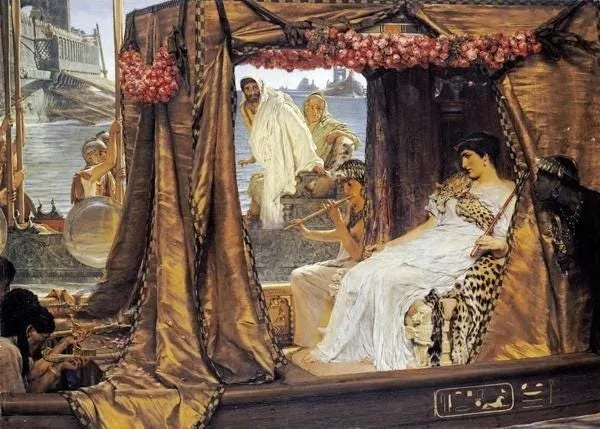
You know ROMEO AND JULIET. The entire world knows this play as a sublime expression of love, and more particularly of young overpowering love that conquers even death. But how many know ANTONY AND CLEOPATRA, two mature lovers who disdained earthly kingdoms and indeed lost them in preference to their love for each other? Some today would not lose a hamburger over love, to say nothing of the kingdom of the entire known world. Marc Antony did lose his position as king of the world directly because of his greater love for Cleopatra. Love was more powerful than death in the ancient world. Certainly, it was to Antony. How valuable to see this story unfold a second time through Shakespeare’s eyes, after the dry officiousness of Augustus Caesar prevailed over Antony even as he buried a Roman republic of 500 years and ushered in an age of slavery and imperialism that did not die out completely until the Russian Tsar and the German Kaisers lost power at the beginning of the last century.
A MIDSUMMER NIGHTS DREAM is perhaps Shakespeare’s most treasured comedy. It is delightfully ridiculous and entertaining, with a bumbling fool named Bottom, turned into a half donkey through the wiles of a fairy, who bumbles through this tale of courtship mistaking sex for love. The play rambles through the most ridiculous aspects of love, yet unites love ultimately to marriage in a way that tragically we modern folk may consider contrived if we were to see it in a movie. At the same time, the play deals directly with the relationship between art and life, between the imagined and the real that I mention above. It serves up the ridiculous in search of the sublime. We can laugh at an ass named Bottom, who stages a play in Act V reenacting PYRAMUS AND THISBE, which is essentially the Romeo and Juliet tragedy, yet Bottom’s play ends in laughter at such an absurd performance, while this Midsummer Dream ends in marriage rather than death as in Romeo and Juliet. We see that love, like so many other things in our lives, has two sides. The happy, the sad. The tragic and the beautiful. Our outcomes are determined by fate, but also the attitude we bring to them. And while this play does not have the stature of ROMEO AND JULIET, it does teach us that laughter is the best medicine for whatever may ail us in this divine comedy of life.